The LEGO Group and Formula 1 put celebrity drivers behind the wheels of brick-built minicars ahead of the Las Vegas Grand Prix in 2026. Announced on 21st November 2026, the inaugural LEGO Race featured 11 stars, each representing a team on the F1 grid. For building fans, the cars deserve a closer look: these moving creations combine thousands of bricks with lights added for their Las Vegas appearance.
The LEGO Group does not support, sponsor or endorse BrickDb and is not affiliated with this post.
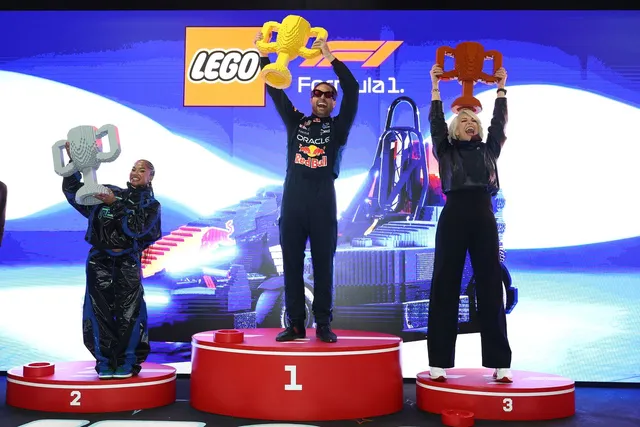
What happened at the Las Vegas LEGO Race
This was a celebrity race held ahead of the Grand Prix, with the stars taking on the role of drivers for the day. The regular F1 drivers joined the occasion by passing the keys to their teams’ minicars to the guest participants. That handover connected the playful event directly to the teams fans follow on the racing grid.
REI AMI, the singer and rapper associated with KPop Demon Hunters, started proceedings by waving the checkered flag. The release describes an event built around fun and chaotic racing rather than a conventional Grand Prix contest. Its central idea was to bring play into the F1 setting, with familiar faces from entertainment and sport doing the driving.
All Formula 1 teams were represented among the 11 entries. That matters to fans looking for their own team’s involvement: the event was not limited to a selection of competitors. The LEGO Group presented the race as another celebration of its Formula 1 partnership, using the track itself as the setting for a different kind of brick-built activity.
Which celebrities represented the F1 teams
Music performers had a strong presence on the grid. Carl Cox drove for Mercedes, while LISA represented Ferrari and FISHER took the Red Bull entry. McLaren’s guest driver was Gordon Ramsay. Jack Whitehall represented Racing Bulls, and Dynamo drove for Alpine. The line-up brought DJs, a singer, a chef, a comedian and a magician into the same race.
The other entries extended that mix into gymnastics, acting and television. Jordon Chiles represented Haas, Hannah Waddingham drove for Audi, and Caleb McLaughlin took the Williams minicar. Brendan Hunt represented Aston Martin, while Terry Crews drove for Cadillac. Each celebrity was paired with a team rather than simply joining an unconnected group of guest drivers.
If you follow a particular team, those pairings give you a straightforward way to follow the event. They also make the race distinct from the earlier drivers’ parade mentioned in the announcement. Here, the people at the wheels were stars invited to become drivers for the day, with the F1 drivers participating through the key handovers.
The minicars brought bricks and lights to the track
Each minicar contains more than 28,000 LEGO bricks and can reach speeds of up to 25km/h. Those details make clear that these were moving builds, not simply display models placed beside the circuit. For a building fan, the combination is the interesting part: a large brick-built creation also had to serve as a vehicle for its celebrity driver.
The cars had already appeared earlier in 2026 during the LEGO Drivers Parade at the British Grand Prix. Their Las Vegas appearance therefore involved further enhancements to existing minicars, rather than the debut of an entirely new fleet. The release specifically identifies LED lighting as an addition for this occasion, linking the builds to the bright surroundings of the host city.
Lighting also reflected the event’s neon theme. That gives you a detail to look for when watching the race, beyond the driver names and team associations. The announcement does not describe the placement of individual lights or the wiring inside the cars. It confirms the illuminated effect without offering a technical guide to how that effect was achieved.
Where the moving builds were developed
Development took place at the LEGO Group’s factory in Kladno, in the Czech Republic. The project involved 20 people working across design, engineering and LEGO building, with 6,400 hours spent developing the minicars. The involvement of those different skills is an important part of the story behind the finished vehicles seen on the Las Vegas track.
For anyone who enjoys building, this is a chance to look beyond the finished shape and think about the work behind a moving model. The release puts engineering alongside brick building, rather than treating the cars only as decorative objects. Their ability to move and carry the guest drivers gives that development work a practical purpose within the event.
There are limits to what you can learn from the announcement alone. It does not explain the drive system, internal structure or building sequence, and it gives no dimensions for the vehicles. You can appreciate the scale of the brick count and the development effort without assuming these minicars use the same construction methods as a model you might build at home.
Who won and where you can watch the race
FISHER won the inaugural celebrity LEGO Race while representing Red Bull. His prize was a trophy built from LEGO bricks, extending the building theme from the vehicles to the award. The announcement names him as the winner but does not provide a full finishing order, so it does not establish where each of the other guest drivers placed.
Fans can watch the race on F1 YouTube. If the illuminated cars are what caught your attention, the footage offers a way to see them in the event rather than relying only on the written description. You can also follow the celebrity drivers and the team pairings that gave the race its connection to the Formula 1 grid.
The release supplies no running time, lap count or detailed account of overtaking and other race moments. It also does not announce another celebrity race. The useful takeaway for now is specific: this Las Vegas event has a named winner and a stated place to watch it, while further racing plans are not part of the announcement.
What this announcement means for building fans
This is event news, not a retail set announcement. The release describes the minicars used on the track but does not offer them as products for fans to buy. There is no catalogue set number or home-building instruction information attached to these vehicles. Keeping that distinction clear helps if you arrived hoping to find a new Formula 1 model for your shelf.
The appeal instead lies in seeing LEGO bricks used in a public racing setting, with movement and lighting forming part of the finished creation. The brick count, development location and involvement of engineers give you concrete details to consider. They do not amount to instructions for recreating the cars, but they explain why the builds are more than background scenery at the event.
The partnership’s stated focus here is playfulness and participation. Celebrity guests took over the driving roles, F1 drivers joined the handover, and brick-built vehicles became the centre of the race. For fans of both building and Formula 1, that is the connection to enjoy: a familiar sporting setting temporarily made room for a race whose cars and trophy were rooted in LEGO building.
Frequently asked questions
Who won the celebrity LEGO Race?
FISHER, representing Red Bull, won the inaugural race and received a trophy made from LEGO bricks.
How many bricks were used in each minicar?
Each minicar contains more than 28,000 LEGO bricks. The vehicles can reach speeds of up to 25km/h.
What changed for the Las Vegas appearance?
The minicars received LED lights to reflect the neon theme and the bright surroundings of Las Vegas.
Where can you watch the race?
The LEGO Group’s announcement says fans can watch the race on F1 YouTube.
Source
LEGO Group press release of 21 November 2026: LEGO® F1 LAS VEGAS GRAND PRIX LEGO Race
This post was written in our own words with AI assistance from the LEGO Group's press release linked above. BrickDb is not the LEGO Group and does not speak for it.
LEGO® is a trademark of the LEGO Group of companies. The LEGO Group does not sponsor, authorise or endorse this application.